
Beyond the Classroom Walls: How Context Shapes School Health Implementation
School health programmes have enormous potential. They can improve nutrition, encourage physical activity, support mental wellbeing, and help children develop healthy habits that last a lifetime. Yet a question continues to puzzle researchers, practitioners, and policymakers alike:
Why does the same programme thrive in one school but struggle in another?
It’s tempting to look for answers in the programme itself. Was it designed well? Were teachers properly trained? Were enough resources provided?
These questions matter. But they don’t tell the whole story. Increasingly, implementation researchers are recognizing that success of the health intervention programs depends not only on the intervention itself but also on the context in which it is implemented.
Context Is More Than “Where” a Programme Happens
Imagine two schools implementing the same health promotion programme. One school has supportive leadership, engaged teachers, active parental involvement, and sufficient resources. The other faces staff shortages, competing demands, and limited funding. Even though both schools receive the same programme, their experiences and their results may be very different.
To understand why one school succeeds while another struggles, we need to understand context.
When people hear the word context, they often think of setting or physical environment, for example, a rural school versus an urban school. But context extends far beyond place alone. It includes the people involved, relationships within the school, community values and beliefs, available resources, education policies, and broader environment. Together, these factors shape how a programme is introduced, adapted, implemented, and sustained.
The challenge is that although researchers frequently acknowledge the importance of context, there has been surprisingly little agreement on exactly what context includes or how it should be studied in school health implementation.
Looking Across Two Decades of Research
To better understand this issue, a team of Changemaker researchers led by Madhura Joshi reviewed 37 studies exploring how context has been understood in the implementation of school health programmes.
Rather than focusing on programme outcomes, we asked a different question:
How have researchers understood and studied context when implementing school health programmes?
The review revealed four key insights that challenge how we currently think about context in school health implementation.
Researchers Don’t Always Mean the Same Thing When They Talk About “Context”
One of the clearest findings was the lack of a shared understanding of context. Studies considered different factors from leadership and resources to culture, community influences, and policy environments as context. This made it difficult to arrive a one commonly agreed definition of context in the school health programs.
Looking Beyond the School Walls
Most studies focused on factors within schools, such as leadership support, teacher engagement, organizational readiness, governance, and resources. These factors are undoubtedly important.
However, broader contextual influences including community norms, cultural values, political priorities, and economic conditions received much less attention, despite their potential to shape implementation and long-term sustainability.
The review suggests that understanding school health implementation requires looking beyond the school itself to the wider social, political, cultural, and economic systems in which schools operate.
Schools are always changing
Schools are constantly changing. Leadership changes, teachers move on, policies evolve, funding shifts, and community priorities change. As a result, context cannot be measured once and forgotten about; it requires ongoing attention throughout implementation. Implementation itself can also change the context, creating new opportunities and new challenges over time.
We Know Too Little About Many Parts of the World
Most of the available evidence came from high-income countries. This leaves important knowledge gaps about how school health programmes are implemented in low and middle-income countries, where education systems, health systems, resources, and social conditions may differ substantially.
A New Way of Thinking About Context
To address these gaps and provide a more comprehensive way of understanding context, the researchers developed the Contextual Framework for School Implementation (CFSI). The framework is presented in Figure 2 of the original publication and is also shared below for reference.
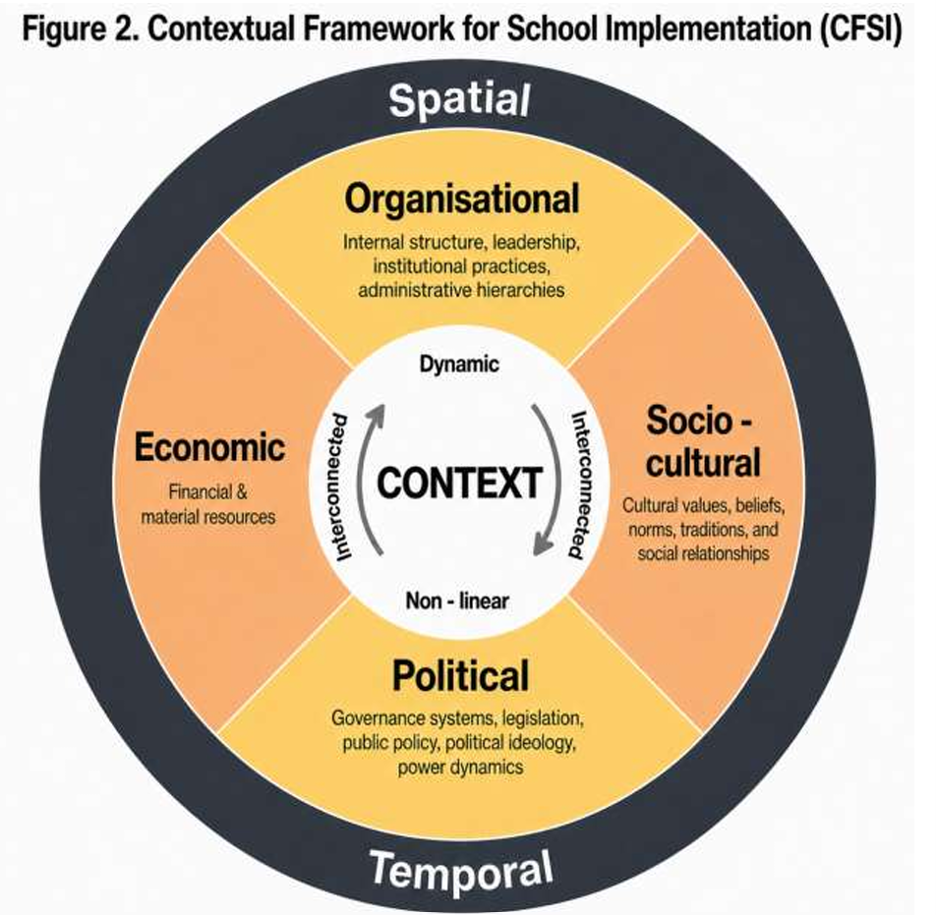 |
Figure 1: Contextual Framework for School Implementation (CFSI)
Drawing on evidence from across the review, the framework moves beyond viewing context as a simple checklist of barriers and facilitators. Instead, it highlights context as:
- Multidimensional, including organizational, socio-cultural, economic, and political factors.
- Interconnected, with different contextual factors influencing and shaping one another.
- Dynamic, changing throughout implementation processes.
- Shaped by time and place, meaning that what matters may vary between schools and across different stages of implementation.
The framework also provides practical questions to support understanding of context across different phases of implementation, from planning and delivery to evaluation.
The Bigger Picture
The key message from this review is not simply that context matters. It is how we understand context that matters. Moving beyond static checklists towards a more dynamic understanding of context can help researchers, practitioners, and decision-makers better design, implement, adapt, and evaluate school health programmes. Applying this broader understanding of context throughout the implementation process is essential if school health programmes are to move beyond good intentions and achieve lasting improvements in the health and wellbeing of children and adolescents.
Reference
Joshi Madhura, Linnansaari Anu, Ngowi Jackline, Mwaniki Elizabeth, Kashamba Kevin, Atkins Salla.
Understanding context in the implementation of school health promotion: a scoping review and conceptual framework.
Systematic Reviews (2026). https://doi.org/10.1186/s13643-026-03232-8

0 comments